The Architecture of Ambition: When Buildings Become Statements
A study of architectural identity, vertical ambition, and the details that distinguish a building from the skyline around it. Through a monochrome frame, we exp
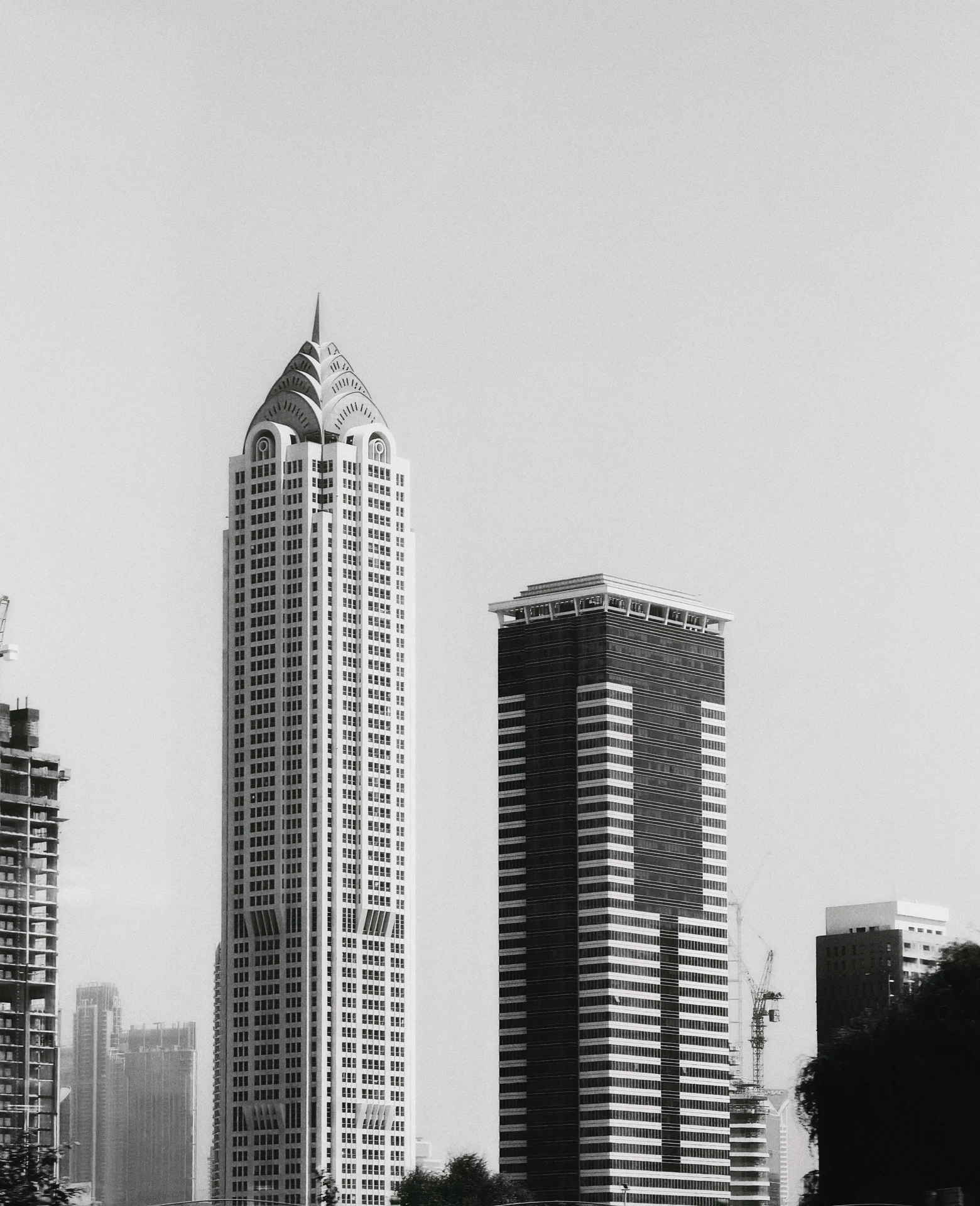
Black and white cityscape featuring two prominent skyscrapers
Cities are often understood through their skylines. From a distance, buildings merge into a collective silhouette, forming the visual identity of a place. But occasionally, a single structure interrupts that rhythm. Not necessarily because it is the tallest, newest, or most expensive, but because its design gives it a presence that is difficult to overlook.
This photograph captures one such moment.
Beyond Height and Scale
The tower rises above its immediate surroundings, distinguished by a crown of overlapping metallic arches and a narrow spire. Its design introduces a different architectural language into an otherwise repetitive urban landscape.
The influence of Art Deco is particularly noticeable in its upper structure. Geometric repetition, strong vertical lines, and ornamental detailing recall an era when skyscrapers were designed not simply to accommodate people, but to represent progress through their physical appearance.
The building's crown becomes its defining feature. While the lower floors follow a disciplined arrangement of windows and structural elements, the upper section introduces a sense of individuality.
It is an interesting contrast between functional repetition and architectural expression.
The Visual Language of Ambition
Architecture has long been associated with economic development, technological advancement, and the ambitions of growing cities.
Yet ambition in architecture is not exclusively measured in metres.
It can be found in the decision to introduce a distinctive silhouette, to invest in details that serve an aesthetic purpose, or to design a structure that contributes something recognizable to the urban environment.
The tower in this frame illustrates that distinction. Its repetitive facade communicates scale and function, while its elaborate crown gives the building an identity beyond its practical purpose.
These are two different aspects of the same structure: the infrastructure that makes a building useful and the design that makes it memorable.
Why Monochrome Changes the Perspective
Removing colour from an architectural photograph changes what the viewer notices.
Without the distraction of reflective glass, surrounding colours, or atmospheric tones, attention shifts towards geometry, contrast, texture, and proportion.
Here, the monochrome treatment emphasizes the relationship between the tower's bright facade and the darker recesses of its crown. The repeating windows become a visual pattern, while the pointed spire draws the eye towards the upper edge of the composition.
The generous negative space surrounding the tower is equally important. Rather than filling the frame with the entire skyline, the composition allows the building to stand apart from its environment.
Neighbouring structures remain visible at the edges, providing context without competing for attention.
The result is less a conventional cityscape and more an architectural portrait.
A City Is More Than Its Skyline
Urban development is frequently described through numbers: construction investment, building heights, population density, and infrastructure capacity.
Photography offers another way to document that development.
A photograph can preserve the decisions embedded in a building's design, the relationship between structures constructed in different periods, and the architectural character that emerges as a city grows.
What appears to be an ordinary part of the skyline today may eventually become a recognizable marker of a particular period in urban history.
This is one of the quieter contributions of architectural photography. It records not only what a city looks like, but also how it chooses to present itself.
And sometimes, understanding a city begins with examining a single building rather than the entire skyline.
From the Frameola community
This architectural perspective was captured and shared by @glm_cil , highlighting the geometry, contrast, and distinctive character of the urban landscape through black-and-white photography.